Saturday, June 24, 2006

Morning Raga


I finally got around to putting some Mad Man's Laughter sound files online. Sean and I will make the official internet debut next fall, once we've completed our summer projects. But for now... here's a few improvised and composed pieces... or whichever ones I get around to loading on that crappy website called myspace.

Wednesday, June 21, 2006

A good read...


Cornelius Cardew gets down on the essense of improvisation, music, and humanity in Towards an Ethic of Improvisation. If you don't read the whole thing, at least skip to the virtues that a musician can develop.

Music is Erotic


Postulate that the true appreciation of music consists in emotional surrender, and the expression music-lover becomes graphically clear and literally true. Anyone familiar with the basis of much near-eastern music will require no further justification for the assertion that music is erotic. Nevertheless, decorum demands that the erotic aspect of music be approached with circumspection and indirectly. That technical mastery is of no intrinsic value in music (or love) should be clear to anyone with a knowledge of musical history: Brahms was a greater composer than Mendelssohn, though it can be truly asserted that Mendelssohn displayed more brilliance in technical matters. Elaborate forms and a brilliant technique conceal a basic inhibition, a reluctance to directly express love, a fear of self-exposure.

Esoteric books of love (the Kama Sutra for example) and esoteric musical theories such as Stockhausen's and Goeyvaerts' early serial manipulations lose a lot of their attraction when they are readily available to all.

Love is a dimension like time, not some small thing that has to be made more interesting by elaborate preamble. The basic dream -of both love and music- is of a continuity, something that will live forever. The simplest practical attempt at realising this dream is the family. In music we try to eliminate time psycholgically [sic] to work in time in such a way that it loses its hold on us, relaxes its pressure. Quoting Wittgenstein again: "If by eternity is understood not endless temporal duration but timelessness, then he lives eternally who lives in the present".

Tuesday, May 23, 2006

Friday, May 19, 2006

Psychedelia

I totally wasn't expecting this.

Wednesday, May 17, 2006

MML


Desire, ergo, suffering, ergo sum: salvation or tranquility

How do you do, sir?
She said as you kissed her
to fly or to transfer
next to by after

I'll sing to them faster
Said their queen pastor
next to or after
the mad man's laughter

Saturday, April 22, 2006

Healthy Forest Initiative


Ah google. My window to the world.

Today Google's logo was decorated by solar panels. Must mean it's earth day. Sure enough, a click on the logo took me to earth day search results. A few clicks later I found myself looking at the United States Government web page for earth day. How exciting! I wonder what the United States Government, the wealthiest, most moral, most visionary, most fantabulous government in the history of human civilization, was doing to celebrate our mother earth. What were the great resources of our great people doing to protect and serve our planet? What were the intentions of the brightest, healthiest, most-god-blessed civilization doing to preserve our life sphere for future generations?

Well, one thing I found was the Healthy Forest Initiative. Sadly, I have only learned about the HFI through liberally biased networks. I've heard something or other about it pressing legislation that would allow loggers the right to cut once protected forests under the guise of "preventing forest fire." But that was liberally biased. What is the government's side?

Why is the Healthy Forests Initiative Needed?

In recent years, most of us have seen televised pictures of wildland fires, evacuated communities, burned homes, and blackened forests, or witnessed these fires first hand. In 2002, Arizona, Colorado, Oregon and New Mexico, each had their largest timber fire in a century. The most devastating series of wildland fires in state history swept Southern California during October 2003. These fires killed 24 people, destroyed more than 3,700 homes, and burned 750,000 acres. Alaska set a record for acres burned in 2004. And, while fire has always helped shape our landscape, today's fires are not those of the past; they are often hotter, more destructive, and more dangerous to fight.


Wow. That's wierd. I wonder how these new mutant fires came to be. I mean, the forests seem to have been here much longer than we have. Why the sudden need for a rescue?

We know in part the reason for the difference. Compared with earlier times, many of today's forests often have unprecedented levels of flammable materials including among other materials: underbrush, needles, and leaves. In the interior West for example, Ponderosa pine forests range from Arizona and New Mexico northward into Idaho. A century ago such a forest may have had some 25 mature trees per acre and be easily traversed on horseback or by a horse-drawn wagon. Today that same forest may have more than 1,000 trees on the same acre creating conditions that are much too thick for the passage of a hiker. These tightly packed trees are smaller, weaker, more disease prone, and more susceptible to insect attack than their ancestors. Such forests form huge reservoirs of fuel awaiting ignition, and pose a particularly significant threat when drought is also a factor.


Hmmm. Forests are flammable? That's crazy. So the more they thrive, the more prone they are to self destruction. You'd wonder why God would make such a crazy, self defeating ecosystem.

Just as we know the reason for current devastating fires, we also know the solution. Wildfire requires three elements: heat, oxygen, and fuel. We can manage neither heat nor oxygen, but we can remove hazardous fuels and make them unavailable for fire's inevitable appearance. HFI helps make that happen by reducing unneeded paperwork and processes thus shortening the time between when a hazardous fuels project is identified and when it is actually implemented on the ground.


Oh. By hazardous fuels I'm sure you mean trees. I gotcha. Just wanted to be clear on that symbolic step forward. So HAZARDOUS FUEL = TREES. Okay. I'm clear. Yep. Sure, lets continue.

HFI accomplishes its goals through administrative reforms and legislative action.


Bush With Tree


As I went on reading, I found out that trees were at higher risk for insect infestation and disease. They were at risk of sustained periods of drought. And creepy crawly suburbia was not at risk since it burrowed its way into these cancerous trees. I also found a quote of Bush claiming "analysis paralysis."

hee hee. analysis paralysis.

While I am quite the expert of analysis paralysis and I do support bold, mythical steps in the escape thereof, Bush's context and logic techniques make me suspicious. Does that mean I'm paranoid?

Lets just put it this way.

Dear Mr. Government:

I support a healthy forest ecosystem that sustains itself for the remainder of our planet's existence. I understand that forest fires have been around since the oxygen and forests first met, and I strangely assume that the ecosystems have, through natural selection, assumed the adaptations that create the most sustaining characteristics possible. My question: is my assumption wrong? Are forests not able to behave in such a way as to secure their own future existence? Why are forests creating more "fuel" which makes fires "hotter" and "more destructive" (presumably towards the point of annihilation if we're concerned with saving them so much)? Are we in any way performing harm towards ecosystems? I mean, are we sacrificing one good for another?

Forgive me if I ask this, I don't mean to offend your integrity. But was the Healthy Forest Initiative in any way influenced by the profit-based intentions of the logging industry?

Thank you for your time.

Troy

Sunday, April 16, 2006

Ambigious Truth


Seigneur! Seigneur!
Musique et Poése m'ont conduit vers Toi: par image, par symbole, et par défault de vérite.
Seigneur! Seigneur!
Seigneur, illumine-moi de ta présence! Délivre-moi, enivre-moi, éblouis-moi pour toujours de ton excés de vérité...
(Il meurt.)

Lord! Lord!
Music and poetry have led me to Thee: by image, by symbol, and in default of Truth.
Lord! Lord!
Lord, illuminate me with Thy Presence! Deliver me, enrapture me, dazzle me for ever by Thy excess of Truth...


The Egyptians built the pyramids. The Romans built the Pantheon. The Saxons built Stonehenge. Messiaen built the opera St. François d'Assise. Messiaen's greatest masterpiece ends the life of St. Francis with lines inspired by St. Thomas Aquinas.

I wasn't raised religious. I am not a religious man. But I find that this quote resonates with my outlook. Perhaps my connotations of the word "Lord" are a bit more ambigious...

... but isn't that exactly it?

Saturday, April 15, 2006

Field Report


Sean and I (The Mad Man's Laughter) have been hired by Pig Iron Theater to provide original composition and sound design for their upcomming production "Love Unpunished." Details on the actual vision of this production will follow in time, but for now, lets say that the set consists of a gigantic stairwell that resembles those found in... american skyscrapers...

Certain words seem to be thrown around quite comfortably now, including...
meditation on death. prayer.

So Sean and I took a trip to a VT college where Sean's incredible friend hooked us up with some amazing studio space. The first night we played in an auditorium the size of a basketball court. I didn't think much of it at first, but I began to feel a strange comfort and energy while simply being present. I finally took a moment to really look around and noticed that the entire place was made of beautiful wooden panels which stretched from floor to the hundred foot ceiling. It reminded me of the orchestral studios I've seen in pictures of the 1950s NBC symphony.


The gods couldn't have been more generous as there was a collection of handmade instruments which were gathered for an upcomming celebration for the late composer who had crafted them. Every once in a while a chime would ring on its own, or a string would vibrate without us touching it, and we couldn't help but smile thinking that the spirit of that old composer was watching us with pleasure.

We wrote a piece for three parts which was based on a 66 beat cycle. This was performed on gamelan style instruments-- microtone vibrations and all. Practicing the cycle for two hours put us all in a very comfortable, focused frame of mind which proved to be particularly effective come our improvisation time.

Among other things, we improvised on three timpani, vibes, chimes, gongs, strange 20ft banjos strung with piano strings, and of course, piano.

The music is very beautiful and interesting and I can't wait to write more about this as the process continues. I will say that I believe that the future of this project looks fertile enough to produce what I may consider my first piece of public art.

Tuesday, April 04, 2006

Feldman and Cage and Radio


Feldman: John, wouldn't you say that what we're dependent on we call reality and what we don't like we consider an intrusion in our life. Consequently, I feel that what's happening is that we're continually being intruded upon.

Cage: But that would make us very unhappy.

F: Or we surrender to it. And call it culture.

C: Call it culture?

F: Or whatever.

C: Give me an example. What would be an intrusion in your life that you would call culture?

F: Well this weekend we were on the beach, and on the beach these days are transistor radios blaring out rock and roll. All over.

C: Yes. And you didn't enjoy it?

F: Not particularly. I adjusted to it.

C: How?

F: By saying that... well, I thought of the sun and the sea as a lesser evil.

(Laughing)

C: Well, you know how I adjusted to that problem of the radio in the environment? Very much as the primitave people adjusted to the animals that frightened them and which probably, as you say, were intrusions. They drew pictures of them in their caves. And so I simply made a piece using radios. Now whenever I hear radios, even a single one-- not just twelve at a time, as you must have heard on the beach, at least-- I think they're all just playing my piece.

(Laughing)

F: That might help me next weekend.

C: And I listened to it with pleasure. And by pleasure I mean: I notice what happens. I can attend to it, rather than, as you say "surrender," I can rather pay attention and become interested in the... well what you're actually interested in is what superimposes what-- what happens at the same time together with what happens before and what happens after.

Wednesday, March 15, 2006

Recycle (part 1)


In my daydream this afternoon I somehow made my way back to the days following Hurricane Katrina. I remember visiting my folks and basking in the glorious poison of cable TV... something to the tune of Fox News. Yeah, I watch Fox News from time to time-- for entertainment purposes, surely. Sometimes there's enough balony to muster up a real full-belly laugh, or at the very least, I try to predict the material for tomorrow's Daily Show. Anyway, railing at Fox News is old hat, but like I said, it's just a daydream. I remember (maybe Hannity was it?) interviewing an environmentalist who had a lot to say about the man made set up for disaster. (Hannity was it?) then ended the interview saying "well, nature really owes us one now."

!

Can you say, Mr. Burns?


Lisa: You never heard of recycling? It means to reuse things to conserve our natural resources.

Mr. Burns: OH? So mother nature needs a favor?? Well maybe she should have thought of that when she was besetting us with droughts and floods and poison monkeys. Nature started the fight for survival and now she wants to quit because she's losing. Well, I say, HARD CHEESE.

Tuesday, March 14, 2006

got back (while he can)


sometime, to name a few,
we go back
oh, now i remember

that somewhere, in plain view,
a voice sustains
to whichever number

and if then, by some meager virtue
the havenots supplicate you

go back
go back
go back
go back
go back
go back
go back

Sunday, March 05, 2006

Why I hate philosophy (but always come crawling back like a scared little girl)


It seems that debates over the logical conclusions resulting from logical conclusions have been centering around "postmodernism"-- whatever that means. As far as I see it, western rationalism interprets reality in an order somewhat resembling:

1. Biological recognition through sensation: hear, touch, feel, get burned!
2. Immediate "emotional" categorization-- assign the perception to one of two places: pay attention and remember or ignore.
3. OH i'm bored and lazy already. Lets skip a few steps.
4. Rationalism identifies the true nature of reality: nothing has objective value. Objective value is an illusion placed on an object/idea/behavior/etc. by the valuer. Value does exist, however it is determined by the limits of a system which are invented by a particular frame of consciousness. The limits of a frame of consciousness result from: survival necessity (nature), intrinsic artistic beauty (some bastard child of the survival necessity), and *eh em* nurture (for god sakes, I love E.T. no matter how sentimental I know it is. I love Reeses Pieces too). Sometimes value is shared by groups of people, sometimes not. (as a side note, I'm convinced that most "agreements" are a result of miscommunication. If spoken/written language was nearly as precise as our pure thoughts are, we would find that the subtleties of difference are humongous. But who knows, really?)
5. In other words, pure rationalism = nihilism.
5(a). Nihilism sucks.
6. Postmodernism says there is no objective value because we all place our own value on things. But even this observation has no objective value. The value of looking at things objectively is also an illusion. In a strange turn of events, postmodernism says to the observer/academic/gaunt cynic from the underground: Hello!! are you going to be part of the human race or are you just going to translate experience into an incredibly inefficient language of "if this, then that."
7. Rationalism, when not taken to its ultimate logical conclusion, is a mystical wonder that brings us buggies without horses and self-cooling houses and theories and berries* and cherries* (*all spoken with mid-western accent)
8. Rationalism, when taken to its logical conclusion, is a bitch that ignores the cries of her only child because, well... why not?


I hate philosophy because it teases a human out of their humanity. But once the human has entered that cold, naked place, oh how greatful they are for their fickle desires and senseless appreciations of beauty which require no philosophy to experience, but a shit load to explain.

But when there's not enough manual labor in one's life, they tend towards "higher things" and in our limitless boredom, we indulge in intellectualism like me on sour skittles... and eventually the tastebuds are burnt out and everything tastes like hurting.

Of course, I'm completely wrong about all of this. I'm generalizing, and incredibly lazy in my approach. I'm even indulging. Not to mention hypocritical.

Blah.

Tuesday, February 21, 2006

Animal Collective is totally awesome


While filling my daily quota of procrastination via web surfing, I decided to look into a band recommended to me a while back. Animal Collective is a quartet from... I'm just gonna copy and paste the description from R5 productions:

The Brooklyn-based modern folk group comprised of DEKAN, GEOLGIST, AVEY TARE and PANDA BEAR under their ANIMAL COLLECTIVE moniker. Built around the AVEY TARE and PANDA BEARS gorgeous harmonic vocals and twin acoustic guitar strumming, the group moves from chiming acoustic guitar songs to gentler, more dispersed picked ballads to sprawling, guitar-swell psychedelics, bubbling, acid-warped vocal effects, and tribal, almost shamanic trance-outs based around looping vocals and hypnotic kick-pulses. Influences range from the Holy Modal Rounders to Simon & Garfunkel, Syd Barrett, the Beach Boys, the Incredible String Band, Brazilian tropicalia, Gilberto Gil, Milton Nasciemento, Black Dice, and beyond. Sweet melodies, big catchy hooks, and a ton of focus and personality.


After listening to a few of their tracks (which are posted on the R5 site) I totally had one of those they beat me to it moments. Now I'm going to wallow in my own creative hollows while soaking in those AC melodies, flickering back and forth between real time and... .. .

Sunday, February 19, 2006

To know us is to know our music


I'm not sure why, but lately I've been experiencing some circular thinking regarding the communicative powers of music. When I expose a friend to Messiaen or Bach for the first time, my hands burst into the air and I say, "he was trying to communicate his thoughts on God-- his deepest spiritual philosophies... isn't it interesting that a man so religious... who could have chosen to preach or write essays... chose music as the method?"

I've also stopped composing for the most part. Or... well, I'm composing, but lets not get into that project. Instead, I'm playing free-improvised music as a way to explore and connect. And I've been completely amazed and grateful to have found a connection to some kind of earthly root, where my reptile brain is given opportunity to say something, and holy shit! It's beautiful!

These experiences have motivated me to explore my "world music" collection which includes mostly gamelan, east and west african music, and some indian ragas. In tribal conditions, music served a very spiritual purpose. And as I explore my own improvising inclinations more and more, and I am noticing similarities to tribal music. How interesting. And now, although I'm certainly guilty of imposing my will to some extent, even Bach, Messiaen, Scriabin, and Alkan are relating to this tribal music. There is a sense of obsession to texture, timbre, and repetition. There is a sense of surrendering.

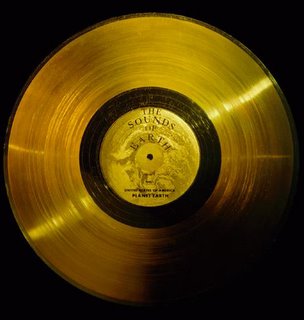
THEN... I somehow had the urge to look up the Voyager golden record. You remember, the one that was shot off to space so that aliens light years away can learn about our beautiful planet and diversity of life, behavior, and ultimately culture and art. The record included audio excerpts of animal sounds as well as sound of the earth like rain and wind. Also included were examples of music from cultures around the world. Bach prelude in C major was the only piece I knew for sure was included since I remember it being referenced in Thirty-Two Short Films about Glenn Gould. But what else was included? What did the panel decide? What mix-tape was fit for intergalactic travel?

* Bach, Brandenburg Concerto No. 2 in F. First Movement, Munich Bach Orchestra, Karl Richter, conductor. 4:40
* Java, court gamelan, "Kinds of Flowers", recorded by Robert E. Brown. 4:43
* Senegal, percussion, recorded by Charles Duvelle. 2:08
* Zaire, Pygmy girls' initiation song, recorded by Colin Turnbull. 0:56
* Australia, Aborigine songs, "Morning Star" and "Devil Bird", recorded by Sandra LeBrun Holmes. 1:26
* Mexico, "El Cascabel", performed by Lorenzo Barcelata and the Mariachi México. 3:14
* "Johnny B. Goode", written and performed by Chuck Berry. 2:38
* New Guinea, men's house song, recorded by Robert MacLennan. 1:20
* Japan, shakuhachi, "Tsuru No Sugomori" ("Crane's Nest") performed by Goro Yamaguchi. 4:51
* Bach, "Gavotte en rondeaux" from the Partita No. 3 in E major for Violin, performed by Arthur Grumiaux. 2:55
* Mozart, Die Zauberflöte, Queen of the Night aria, no. 14. Edda Moser, soprano. Bavarian State Opera, Munich, Wolfgang Sawallisch, conductor. 2:55
* Georgian S.S.R., chorus, "Tchakrulo", collected by Radio Moscow. 2:18
* Peru, panpipes and drum, collected by Casa de la Cultura, Lima. 0:52
* "Melancholy Blues", performed by Louis Armstrong and his Hot Seven. 3:05
* Azerbaijan S.S.R., bagpipes, recorded by Radio Moscow. 2:30
* Stravinsky, Rite of Spring, Sacrificial Dance, Columbia Symphony Orchestra, Igor Stravinsky, conductor. 4:35
* Bach, The Well-Tempered Clavier, Book 1, Prelude and Fugue in C, No.1. Glenn Gould, piano. 4:48
* Beethoven, Fifth Symphony, First Movement, the Philharmonia Orchestra, Otto Klemperer, conductor. 7:20
* Bulgaria, "Izlel je Delyo Hagdutin", sung by Valya Balkanska. 4:59
* Navajo Indians, Night Chant, recorded by Willard Rhodes. 0:57
* Holborne, Paueans, Galliards, Almains and Other Short Aeirs, "The Fairie Round", performed by David Munrow and the Early Music Consort of London. 1:17
* Solomon Islands, panpipes, collected by the Solomon Islands Broadcasting Service. 1:12
* Peru, wedding song, recorded by John Cohen. 0:38
* China, ch'in, "Flowing Streams", performed by Kuan P'ing-hu. 7:37
* India, raga Bhairavi, "Jaat Kahan Ho", sung by Surshri Kesar Bai Kerkar. 3:30
* "Dark Was the Night", written and performed by Blind Willie Johnson. 3:15
* Beethoven, String Quartet No. 13 in B flat, Opus 130, Cavatina, performed by Budapest String Quartet. 6:37

Phew. Boy is that controversial. Was there really room for multiple examples from a single mind? Beethoven shows up twice, Bach thrice!

This begs the obvious, glorious question. What music would you send to space? Personally, I am one to first consider the purpose. This aspect of the record was created to inform alien intelligent life of our humanity through music. Surely Beethoven and Bach deserve a spot, but I hardly find it reasonable to give them more than a track. If Western European music deserves more time, what about the great melodies? Certainly melody was under-represented. Hmmm... and which melodies are worthy of intergalactic travel? Puccini? Gershwin? Tchaikovsky?

While the webpage loads...


In keeping with my theme of short and incredibly useful posts, I present this: How to exercise while sitting at your computer.

Thursday, February 16, 2006

The Ecstatic Gospel According to the Internal Truth


I may be (unofficially) the resident Chroma Polaris performer in the city of Philadelphia. Come check us out. I'm tellin ya, it's freakin hot.

We're working on names for the trio (Chroma Polaris, Accordian, and Percussion) before September's tour.

Bubble Raga

sleep on it

speaking of not enough time


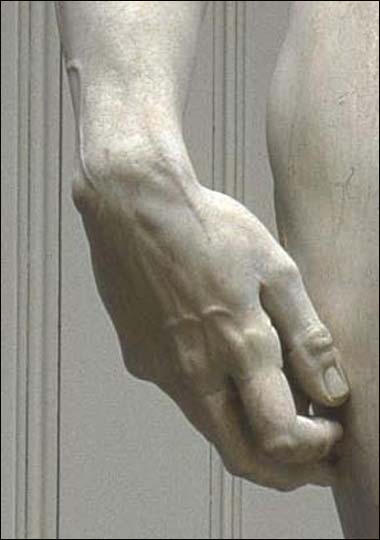
The veins standing out in David's hands show Michelangelo's physiological accuracy of a person in pre-fight stance.

Thursday, February 02, 2006

On Expression, Criticism, Humility, Humor, etc.


...Others for Language all their Care express,
And value Books, as Women Men, for Dress:
Their Praise is still — The Stile is excellent:
The Sense, they humbly take upon Content.
Words are like Leaves; and where they most abound,
Much Fruit of Sense beneath is rarely found.
False Eloquence, like the Prismatic Glass,
Its gawdy Colours spreads on ev'ry place;
The Face of Nature was no more Survey,
All glares alike, without Distinction gay:
But true Expression, like th' unchanging Sun,
Clears, and improves whate'er it shines upon,
It gilds all Objects, but it alters none.
Expression is the Dress of Thought, and still
Appears more decent as more suitable;
A vile Conceit in pompous Words exprest,
Is like a Clown in regal Purple drest;
For diff'rent Styles with diff'rent Subjects sort,
As several Garbs with Country, Town, and Court.
Some by Old Words to Fame have made Pretence;
Ancients in Phrase, meer Moderns in their Sense!
Such labour'd Nothings, in so strange a Style,
Amaze th'unlearn'd, and make the Learned Smile...


...A smudging from Alexander Pope's An Essay on Criticism

Wednesday, February 01, 2006

Rosebud...


Orson Welles is one of the most inventive, influential, and tragic heros of the 20th century. His genius was unchallenged from his teens until his 20s, and by the time he was 24 RKO Pictures gave him the most progressive- trusting in the vision of the artist instead of the members of the board- contract Hollywood had yet to see. With this power and influence, and unchecked vision, Welles made Citizen Kane (did I say he was 24!?).

But the poor bastard was called a Communist and blacklisted from Hollywood. He grew fat and drunk, and eventually made a living doing voice-overs for scotch and frozen peas. Ah, the frozen peas. A legend in its time. Orson's famous voice-over for a british based advertising agency is one of the finest moments of comedy resulting from genius vs. underlings. Orson belittles the producers and writers and eventually becomes so frustrated with the writing and direction that he walks out of the recording session. As mean spirited as it... becomes... I can't help but sympathize. How lonely he must be in this land of refined perceptions. Some of my favorite moments:

That doesn't make any sense. Sorry. There's no known way of saying an English sentence in which you begin a sentence with "in" and emphasize it. Get me a jury and show me how you can say "In July" and I'll go down on you. That's just idiotic, if you'll forgive me by saying so. That's just stupid... "In July"; I'd love to know how you emphasize "In" in "In July". Impossible! Meaningless!

You don't know what I'm up against. Because it's full of, of, of things that are only correct because they're grammatical, but they're tough on the ear, you see. This is a very wearying one. It's unpleasant to read. Unrewarding. "Because Findus freeze the cod at sea, and then add a crumb-crisp" Ooh, "crumb-crisp coating." Ahh, that's tough, "crumb-crisp coating." I think, no, because of the way it's written, you need to break it up, because it's not, it's not as conversationally written.

I spend... twenty times more for you people than any other commercial I've ever made. You are such pests! Now what is it you want? In your... depths of your ignorance, what is it you want? Whatever it is you want, I can't deliver, 'cause I just don't see it.


It wasn't until I heard this clip that I realized Orson Welles was the inspiration for the voice of The Brain from Pinky and The Brain. Wow... that makes it even more entertaining... BTW, what crap are people watching now that Anamaniacs are off the air?

You can listen to the whole clip here.

Thursday, January 26, 2006

You Have Been Chosen


So gmail provided an interesting link in the advertisement section next to the body of a recent e-mail. I typed a short message of concern for a friend, "I hope everything is alright. I know you're busy, but let me know how you're doing when you get the time."

Gmail uses an ingenious algorithym which scans the words of an e-mail for clues which generate the most appropriate advertising links. Apparently this system is one of the worlds most advanced methods of gathering and organizing information.

Next to the body of my concerned e-mail, I couldn't help but notice what Gmail concluded from my two sentences of concern. A single, lonely link was posted: Desperate?

The word, colored in blue hypertext font strangely reminded me of an Alice in Wonderland trip ---take the blue pill--- but you can never return.

Desperate?
Surrounded by troubles?
Overcome by problems?
If you want to see how to save a hopeless situation,
See below


I was only mildly surprised that there was no obvious place to click and send money. What are they selling? Drugs? Books? Videos?

But I went along reading, down a small ladder of logic that was designed to make the reader feel as though their pains are common to most humans.

I often wondered why I respond to a situation the way I respond. Interestingly, I have responded to the same event in different ways at different times, to the extent that one response can be opposite to the previous response. Why?

I have searched for answers. Nothing seems to be final, but I think it is something to do with my beliefs. If my belief about the situation changes, my response changes, even if the situation is the same.


Very systematic...

Why do I choose to believe the way I believe? Most times it is based on experience of the same type of situation in the past and whether it was beneficial to me.

To believe one way or to believe another way is merely a decision based on my belief at that point in time.

Why do I believe what I believe? Because I decide to do so. Making a choice is a decision. I can choose to decide I no longer believe in what I used to believe in. I can choose to believe in something else, even the opposite.

Can I believe in anything? Yes, I merely decide to believe in it.
Am I free to decide to believe in anything? I believe I am free to do so.
I believe that any belief is only one decision away.


Of course this gets to the nature of the question: what is belief?

Belief is created through reasoning and perception whether consciously or unconsciously. The idea that one can choose what to believe is surely a curious position. It stands that if one chooses what to believe, then human reason must have the ability to compartmentalize. For instance, one could reason that all reality is simply temporary beliefs, or an acceptance that patterns will continue uninterrupted until proven otherwise, at which time the belief changes to include the new patterns. But one could also reason that basing one's idea of reality on ever changing beliefs creates an unstable environment which may make one uncomfortable. Since a human may strive for comfort, it is reasonable that one may choose to believe in a steady, unchanging reality in order to maximize comfort and therefore productivity, health, etc.

This is a case in which reason provides two very opposite conclusions once compartimentalized to include the benefits to the one doing the reasoning.

Notice the brilliant encoding of the writer's position in the last few lines highlighted. "Can I believe in anything? Yes, I merely decide to believe in it. Am I free to decide to believe in anything? I believe I am free to do so. I believe that any belief is only one decision away.

The suggestion is that one could take advantage of the maleable nature of belief. The structure of the essay has so far been:

1. Are you depressed? It is likely due to your outlook.
2. Your outlook is based on a system of beliefs.
3. Although beliefs are created through reason, it is compartimentalized reason.
4. The choices you make will adjust the outcome of your reason.

This begs the obvious question. What is one choosing from?

1. Feel good.
2. Feel bad.

Suppose I tell you a fantastic story. It is fantastic because even by stretching my imagination, it sounds too good to be true. But why not hear me out. It may prove to be interesting.


The writer then goes on to explain, quite concisely, the Old Testament's story of creation followed by the history of man leading up to the Messiah.

A few parts are real gems:

There is a catch to this story. Who the creator chooses to hear and to believe this story is entirely up to the creator. Selection is entirely by grace or favor. Nothing I do or don’t do can influence the creator to select me. Interestingly, the selection has already taken place at the foundation of the universe.

Once I believe this story, I stop fearing death. I am enabled by an agent of the creator called holy spirit to focus on the creator’s son, Yeshua. Holy spirit enables me to cast all my cares to Yeshua. When I meet up with a problem, my attitude is as follows. “Hey! I didn’t ask to be created, so it is not my responsibility to solve this problem. Therefore, Yeshua, please take over.”

The extent that this attitude is employed is the extent of peace of mind I enjoy. The problem may not change immediately but the burden of responsibility is instantly lifted off my shoulders. Many a time, circumstances change and the problem shifts from appearing as a curse to appearing as a blessing.

Should I believe this story?
What if it is fiction?
So what?
What do I have to lose?


What I find particularly interesting is the existence of choice. But the nature of this choice may be very different from one person to the next. Those who acknowledge that their beliefs are based on a reasonable conclusion, whether conscious or not, that every belief originated from some evidence (how much or little depending on the individual's degree of skepticism)and some reasonable sorting of information from there on out, may find this choice to be... well...

humane.

To make rational decisions which are chosen to best serve the characteristics of the human require special study of the human. Yet how does one best understand the nature of a human, as a human? Some say that the study of archetypes reveal universal patterns of desire and fear, therefore revealing deep rooted human characteristics. Some say that intuition is our truest knowledge, and a quieting of the rational mind is in order.

Then some say: everything in moderation.

*gulp*